Showing posts with label Antioxidants. Show all posts

Thursday, June 9, 2011

Green Peas and Fava Beans - Our Fresh Summer Treats!

Fava beans (foul) and green peas (bazella) are one of the favorites Lebanese treats during this time of year, other than green almonds nuts of course!

Fava beans
Green raw peas and fava beans contain significant amounts of carbohydrates and thus they are considered to be primarily constituted of starch. Their protein content is greater than that of potatoes and is actually close to that of rice even though both rice and peas have different types of amino acids (protein building blocks). So a smart way to go around cooked peas is to have them with rice, this way both their protein content will complement each other.
Peas are also rich in vitamin C, in fact, they have  40 mg for each 100 g, almost as much as lemon while fava beans contain about half of that of lemon.
Moreover, green peas and fava beans supply your body with vitamin A, E, B1, B2, B6, folates, iron and zinc and best of all, they supply you with lots of fiber!

Fresh Green Peas
Now apart from all the benefits listed about green peas and fava beans, can these green treats be considered as veggies and thus it's Ok to nibble on them "freely"? 
Well, not really! The issue we have in Lebanon is that during this time of year, everyone buys kilograms of these fresh greens and enjoy them - mindlessly if I might add - with lunches, dinners, picnics or simply with alcohol! So a very important nutritious advice concerning foul and bazella is to enjoy them in small amounts because to start with, they are high in fibers and might not be well tolerated in large amounts causing digestive disturbances and gases and most importantly because they are considered as starch - just like potatoes/pasta/breads/rice and not as green vegetables! This is why it is best to replace them with green munchies such as carrot, cucumber and bell pepper sticks or if you decide to have green peas and fava beans, make sure not eat them as a surplus to other starches in your diet!

Monday, March 14, 2011

Hummus - Just Deee-licious!

Pureed chickpeas may not sound very appetizing, but Hummus, the pretty famous Middle Eastern chickpeas spread, is just de-licious (especially my mom's)! 
Now we often take hummus for granted here in Lebanon, but it's actually a hot food trend abroad! Hummus has virtually taken over the “refrigerated flavored spreads” category, which enjoyed sales of more than $300 million in 2009, according to data from a Chicago-based market research firm.


Even though you can find pre-made hummus in supermarkets, it's just not the same. Now it's actually pretty easy to prepare so here's a the Lebanese quick version which I got verbatim from The Food Blog:
  • Soak chickpeas overnight with a spoon or two of sodium bicarbonate
  • 
    Courtesy of The "yummy" Food Blog
    
  • Boil the hell out of the chickpeas. (now this step will definitely cause your chickpeas to lose some nutrients during the boiling process, diffused in the water).You want to be able to turn it into mush by simply pressing on the grain between your index and thumb
  • Drain but keep the cooking liquid as you will need it, especially that it has some leaked chickpeas' vitamins!
  • Put in a food processor with no other liquid and blend.
  • If the food processor is not blending properly, add tiny amounts of cooking water, and I mean by the tablespoon just to get it going
  • Keep blending until very smooth. If you put too much liquid, it will not get smooth enough, and remain yucky and grainy
  • Add garlic, salt and lemon juice, blend again and adjust to taste.
  • Add tahini paste/sesame seed butter (a bit at a time), blend and taste.
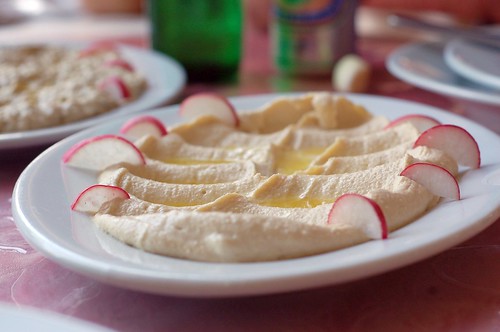
  • Tahini will make the dip seize up, so add a bit of cooking liquid (or lemon juice if it needs it) to loosen it all up, but not too much. It should be be thick and creamy, not liquidy in any way. Have a look at how it holds its grooves in the picture above.
  • Adjust garlic, salt and lemon juice, plate up, make a sort of well in the middle and fill it with good olive oil! (I would say just put 2 tsps of olive oil when you put hummus in your plate because you are already taking your fat in this meal from the tahini)
Now for more chickpeas facts (which are also called garbanzo beans), they are one of the world's oldest cultivated foods, dating back to the Neolithic period in what is now Sicily, according to The Food Encyclopedia. During the Roman Empire, chickpeas were shipped in jars from Sicily to the rest of Italy. But the Middle Eastern region is thought to have created hummus hundreds of years ago by combining pureed chickpeas with lemon juice or vinegar, tahini (sesame seed butter), garlic, and olive oil. 


Most importantly, whether you're new to hummus or a longtime fan, like moi, here are the nutritional benefits which it offers you!


Chickpeas, the main ingredient in hummus, are rich in fiber and lean proteins to start with. They also offer you vitamins and mineral such as folic acid, calcium, zinc and magnesium!
Now beans in general have been linked to lower bloog cholesterol and lower risk of cancer because they are rich in enzymes and antioxidants (such as saponins, protease inhibitors and phytic acid)!
On another hand, tahini (sesame seed butter) is rich in mono-unsaturated fats (the fat that helps to increase the "good" cholesterol HDL) and has additional calcium, proteins and fiber.
And not to forget, last but not least, the vitamin C lemon juice offers you, the monounsaturated fat the olive oil contains and the rich anti-oxidant heart healthy garlic potential!

Balila, courtesy of The food Blog

So be creative and enjoy your hummus:- As a raw vegetable dip: put your hummus bowl in the center and surround it with a rich combination of stick veggies such as cucumbers, broccoli, cherry tomatoes, bell peppers, cauliflowers, etc.
- As a sandwich spread with mint, cucumbers, tomatoes, rockets and olives
- In sandwiches, instead of mayonnaise >> this way you'll cut down your fat intake

- Diluted in water, broth or even wine to make such a delicious dressing for cold pastas
- Mix in a food processor with spices or ketchup to get a different taste and red color or with mint to get green creamy texture
- You can add small bits of lean grilled meat + pine nuts on the top and have it as a main dish with
fattouch on the side (my personal favorite lunch!)
- You can even keep the chickpeas intact (no food processing) and make yourself a nice bowl of "Balila" mixed with garlic, lemon juice, oil and pine nuts!


Now food aside, I was inspired to write this "nutritional' post about hummus because of the Lebanese smart/sarcastic Hummus Nation Blog well, has nothing to do with food!


Sources: WebMD, The Food Blog and The Food Encyclopedia

Sunday, January 16, 2011

Richer Tea From Now ON!

Tonight, it's cold outside and as much as I love cold weather, all I'd want to have is a warm cup of tea. I usually boil water and just place a sachet of tea to blend in, simple and quick.

However, tonight I bumped into a rich mixture of green tea Satya suggested in her Super Yummy Recipes blog and decided to give it a shot. It was a wise thing to do because that's how I want my tea every time: simple, delicious and quick!


Ingredients:
  • 1 tsp honey
  • 1/2 tsp cinnamon powder
  • 1/2 tsp freshly squeezed lime juice
  • 1 cup hot water
  • 1 sachet green tea
  • 1/2 tsp anis, aromatic seeds (this one was an improvise)
The cooking procedure is actually simple, and better yet: it takes the same time you would actually take to prepare a simple - plain tasted cup of tea!
  • Boil water with the anis seeds and set it aside
  • Put the green tea (or plain tea whatever you prefer) in it, and let it blend in for 2-3 minutes.
  • Meanwhile, mix your honey and cinnamon well in your favorite mug.
  • Pour the green tea water into your mug and stir nicely till the honey & cinnamon paste mix well.
  • And last but not least, pour in your lime juice, serve warm and Bonne Appetite!
We usually don't put much input in simple warm drinks like tea; however, this recipe is simple and gives tea such a rich & sharp taste.


Now when you have this delicious cup of tea, not only will you get a warm up effect, but you will also get some nutritive benefits out of it! 
  • Warm green tea has a warm and calming effect to start with. In addition, it's rich in anti-oxidants that help your body fight diseases and may help protect your body cells from damage done by free radicals. Different blends of tea offer different combination of antioxidants, polyphenols and flavonoids. Tea may also supply fluoride which helps strengthen tooth enamel! Moreover, it aids to hinder cavity forming bacteria thus it reduces plaque formation.
  • Honey is 80% natural sugar, 20% water and 2% vitamins and minerals such as vitamin c,vitamin B 6, riboflavin, manganese, calcium, iron, copper, zinc and potassium. These are in small amounts so think of them as bonus! Natural honey has anti-inflammatory and anti-bacterial potential; however, you should keep in mind that it has the same effect on blood sugar as any other sugar and there are 22 calories in 1 tsp of honey.
  • Adding lime juice or any citrus juice adds up for flavor and smart nutrition! Tea's flavonoids partly inhibit the absorption of nonheme iron. A squeeze of Vitamin C rich lemon, orange or lime in your tea can counteract some of this action. Lime also contains a bit of potassium, folate, magnesium and vitamin B 6.
  • Cinnamon powder and anis seeds both contain lots of anti-oxidants and have a cleansing effect on your body so having a small pinch of each will add taste and health to your cup! Cinnamon also offers a bit of manganese, iron, calcium and Vitamin K; whereas anis seeds are rich in anethole and limonene antioxidants with a pinch of many vitamins and minerals such as thiamin, riboflavin, niacin, vitamin C, vitamin A, manganese, iron, magnesium, potassium, zinc and copper.

Wednesday, January 5, 2011

BANANAAA!


Well, I'm a huge movies fan. I came across this last month after I saw the lovely Despicable me movie. However, I find that this short movie fits perfectly in my blog. Just let it buffer and check it out! I personally think we should all act this way around fruits: take them as snacks to work, school, university, wherever. They are trans/saturated fat/cholesterol/refined sugar- free and this way you will increase your intake of various minerals, vitamins and fibers!
Just so that you know, bananas contain vitamin B6, vitamin C, potassium, magnesium and manganese in addition to lots of fiber! Check these Top 10 ways to enjoy Bananas!

BANANAAAA... papple?

(Oh and "papples" have other kinds of minerals and vitamins, so variation of fruits in your diet will give you new and different health benefits every time!)

Five Ridiculously Good Foods!

Avocado 
These smooth, buttery fruits are a great source of not only "good" fats such as mono-unsaturated fats but other key nutrients as well. One Ohio State University study found that when avocado was added to salads and salsa, it helped increase the absorption of specific carotenoids, plant compounds linked to lower risk of heart disease and macular degeneration, a leading cause of blindness. “Avocados are packed with heart-protective compounds, such as soluble fiber, vitamin E, folate, and potassium,” says Elizabeth Somer, RD, author of 10 Habits That Mess Up a Woman's Diet.
However, they are a bit high in calories. To avoid weight gain, use avocado in place of another high-fat food or condiment, such as cheese or mayo and always keep in mind that, after all, it's a fat.  


Oatmeal 
Fiber-rich oats are even healthier than the FDA thought when it first stamped them with a heart disease–reducing seal 10 years ago. According to new research, they can also cut your risk of type 2 diabetes. When Finnish researchers tracked 4,316 men and women over the course of 10 years, they found that people who ate the highest percentage of cereal fiber were 61% less likely to develop type 2 diabetes.

To reap the benefits, eat 1/2 cup daily—preferably unsweetened. For a versatile breakfast, top with different combinations of fruit, yogurt, and nuts. You can also use oats to coat fish or chicken or add texture to meatballs. Check my more detailed article about Oats!


Salmon
Salmon is a rich source of vitamin D and one of the best sources of omega 3s fatty acids. These fats have a wide range of impressive health benefits: form preventing hear diseases to smoothing your skin, decreasing inflammation, aiding weight loss, boosting your mood and minimizing the effects of arthritis.
Moreover, omega 3 aids in decreasing memory loss and slows the rate of digestion, thus, making you feel fuller for longer! Watch out to get plenty of fish - at least 2 to 3 servings per week, this way your body will take its needs of proteins and omega 3 altogether! 


Apples
One of the healthiest fruits you should be eating or you probably already are, hence the saying: "An apple a day keeps the doctor away!" Fortunately, it's abundant in Lebanon. The Iowa Women's Health Study, which has been investigating women for nearly 20 years, names apples as one of only 3 foods (along with pears and red wine) that are most effective at reducing the riskof death from heart disease among postmenopausal women. Other massive studies have found the fruit to lower the risk of lung cancer and type 2 diabetes, even help women lose weight! Apples are rich in fibers, vitamins, minerals and water, so it's actually a win-win situation when you have yourself one of these!

However, keep in mind that one thing can make an apple unhealthy is when it's mixed with caramel, sugar, flour, butter or/& stuffed within a pie or on a tarte! Instead, have a fresh crunchy apple as a dessert or even added to salads!


Dark Chocolate
Yes, yes, dark chocolate! It is filled with flavonoid anti-oxidants that help keep platelets from sticking together, consequently clogging your arteries. It also can help decrease the risk of cancers with its anti-oxidative abilities. And there's more to add! According to a study from Denmark, it may also help you lose weight by keeping you fuller for longer! Researchers gave 16 participants 100 grams of either dark or milk chocolate and 2 hours later offered them pizza. Those who consumed dark chocolate ate 15 % fewer calories that those who had milk chocolate!
So not to make a huge fuss about it, have a small portion of 70 % cocoa or more from time to time! Desserts should not be banned if you are trying to watch your diet, just know what and how much to have!

Wait for more! Brought to you with amendment from Prevention website!

Monday, December 27, 2010

Marbled Chocolate Bark With Mixed Nuts


It’s Christmas and New Year’s time, practically, the season of delicious food! Now most people worry about gaining weight because of the irresistible yummylicious sweets offered all over this season! So I decided to hunt down something edible and delicious for this season. Looking around in A box of kitchen blog, I found this delicious recipe of marbled chocolate bark with mixed nuts!
It’s incredibly easy to make, quick and the best part of it, nutritious!
The ingredients you’ll need for a 24 x 18 cm baking pan are:
· Dark chocolate, 50 g
· White chocolate, 90 g
· Unfried, unsalted, unsweetened nuts (almonds, cashew, macademia, pistachios, walnuts, hazelnuts, etc.), 80 g
· You can also try adding mixture of dried fruits, crackers, biscuits, etc.
Nutrition facts:
Dark chocolate - 70 % cocoa - is rich in antioxidants, has a positive effect on one’s circulatory system, has iron, magnesium, manganese, a bit of vitamin K, zinc and riboflavin! Whereas white chocolate contains calcium, phosphorus, riboflavin and vitamin K. Keep in mind that both types of chocolate contain saturated fats so moderation is a MUST!
As for the mixed nuts, go for the unsalted, unsweetened version of them. They are rich in “good” fats: mono- and poly-unsaturated fats, lots of vitamin E, magnesium, manganese and some riboflavin, calcium, copper and phosphorus!
Preparation:
·         Place the mixed nuts in the processor and blend till the consistency you desire. I prefer the nuts to stay crunchy to the taste so keep them coarse – not very finely chopped, yet not too coarse.

·         Now break the chocolate bars into small pieces and place them in SEPARATE microwaveable bowls. Don’t cover them with any plastic wrap to avoid water coming from the steam. Heat them for 1 minute.


·         After 1 minutes heating, take out the bowl and stir the softened chocolate with a spoon and check if it needs more heating.
·         Line a baking pan with parchment paper, no need to butter it according to Arudhi
·         Place dollops of dark chocolate randomly on the pan. Then, place dollops of white chocolate on remaining spaces.


·         Now, get your rubber spatula and swirl the white melted chocolate within the black. Watch out to over mix the chocolate to keep a marbled color. The more you mix, the less marbly they get.
·         So it’s time to sparkle the nuts on your chocolate. Gently push down the loose nuts so they stick well onto the chocolate.


·         Place in the fridge for around and hour and a half to allow the mixture to stick altogether.
·         After it sets, slowly dislodge the bark from the paper.
·         Break the nutty-marbled-chocolate into chunks and serve!
So instead of gulping holiday sweets full of saturated fats and refined sugars, go for these healthier snacks!
This delicious recipe and mouth-watering photos are all courtesy of A box of kitchen.

Monday, November 29, 2010

Veggies Super-Power Still ON!

No matter how much your mom has nagged about eating your veggies, well she wasn’t lying! Veggies still rank as top ONE! A new study released by the Archives of Internal Medicine reveals that people with high blood levels of the antioxidant alpha-carotene, found in lots a variety of vegetables, were less likely to die during a 14 year longitudinal study (cohort) study compared to people with low levels of carotenoids.


Based on the study, a major factor causing chronic illnesses like cancers and heart problems may be related to high amounts of free radical oxygen that damage your DNA, protein and fat cells. Now it’s important that you know that free radicals’ production is totally normal in your body but the damage they cause can be alleviated by antioxidants’ action, hence carotenoids such as beta carotene, alpha carotene and lycopene. These nutrients are mostly loaded in fruits and vegetables such as carrots, squash, sweet potatoes, pumpkins and dark green leafy vegetables like broccoli and spinach.


What researchers did in this study was monitor alpha-carotene levels in the blood of 15,318 adults, age 20 or older, who participated in the Third National Health and Nutrition Examination Survey Follow-up Study between 1988 and 1994. In 2006, researchers surveyed how many of their sample had died and from what cause. They found that 3,810 had died, and that people with the highest levels of alpha-carotene in the blood were significantly less likely to die than those with lowest levels. In addition they found that a lower risk of cancer and heart disease in people with high levels of alpha-carotene.
So yes, yes having that extra bowl of salad every day in your plate will sure help in elongating your healthy life and in lowering heart and chronic illnesses risks.
Brought to you with the help of: http://healthland.time.com/

Monday, November 22, 2010

Tabboule - the Lebanese Favorite Salad!


With a little experience, like my mom and most Lebanese cooks prepare it, you can estimate the quantities of ingredients by eye when making this delicious and healthy salad: tabbouleh.

Because it's Lebanon's Independence Day today, I decided to tell you more about our country's most delish and famous dish: our beloved tabboule! No doubt that every Lebanese person knows this salad for it's prepared every Sunday in almost every house in the country. After all, it has the same colors like our flag :)

Ingredients
  • 2 cups of finely choped fresh parsley
  • 1/4 cup bulgur, uncooked, fine cracked wheat
  • 1 medium tomato, washed and finely chopped
  • 1/4 cup of finely chopped fresh mint leaves
  • 1/4 cup of finely chopped onions or scallions
  • 1/2 cup lemon juice
  • 1/2 to 1 tsp salt (or to your liking)
  • 1/4 to 1/2 tsp pepper
  • 2 tbsp olive oil
  • Fresh lettuce leaves or cabbage leaves on the side
How to prepare it? It needs a total of 45 minutes with chopping and all!

1. To chop parsley: Sharpen your knife well. Gather several stems of parsley in your hand and pull the stem ends down so that all the leaves are clustered evenly together on one side. Gather the leaves closely together and press against a cutting board. Holding the leaves in place with your left hand, use your right hand to very thinly slice the parsley leaves. Once you've chopped that bunch, you can go back and chop a few remaining big pieces, but avoid going back over the parsley, as further chopping will result in bruised leaves.
It's best if you don't chop them in any automatic appliance, they'll only get bruised and darken.
2. Chop your tomato, scallions and mint the same fine way. It's a good idea to wash all your vegetables before chopping them, this way you'll avoid losing water-soluble vitamins!
3. Put the fine (not coarse) bulgur in a small bucket and wash it for few seconds with water, then drain them. Some people prefer soaking them in warm water for an hour, but this is your personal call.
4. In a large bowl combine your parsley, scallions, tomatoes, mint and bulgur. Then pour in your lemon juice, olive oil, salt and pepper. Toss your mixture well.

It's most delicious served in or with cabbage/lettuce leaves. It is rich with antioxidants like quercetin, lycopene, allium and lutein. These all sound weird/fancy but I'm not trying to mislead you with any. Just know that there are hundreds of antioxidants, some which are still being discovered. The whole point behind them is their potential ability to fight cancer, diseases and aging, so no matter how weird they sound, they definitely are good for you! Moreover,tabboule also has a lot of fibers, vitamin A, vitamin C, vitamin K and monounsaturated fatty acids.

So you see, it looks mouth-watering, it tastes delicious and has such a nutritious value!
You can check the NutritionData Widget on the right to assess the calories in your dish.

Happy Independence Day!

Friday, November 19, 2010

Black Rice - Intriguing?

We've all heard of white rice and brown rice but what about Black rice?

This rice is originally from Asia yet not really black but more of a deep purplish color, giving a dark shade. It has been commonly used as a condiments or as decoration for meals and desserts.
Black rice is rich in iron and fiber, but what is more important is its richness with antioxidants that fight free radicals, helping your body stay young, healthy and disease free! According to a study presented at the 240th National Meeting of the American Chemical Society (ACS), “one spoonful of black rice bran contains more antioxidants than a spoonful of blueberries." And knowing that blueberries has been the talk of antioxidant-interest communities, this is quite the break through! "Black rice offers more fibers and vitamin E antioxidants, but less sugar than blueberries.” I love it already!

Here are some more facts about black rice brought from Blackrice.com
  • One serving of Black rice (1/4 c.) provides 1.5 g of fat, 2 g of fiber and 34 g of carbohydrate and 160 calories.
  • Black rice takes slightly longer time to cook than white rice and needs two cups of water of each cup of rice. It will take around 25-30 minutes to completely cook.
  • Most grocery stores do not yet carry black rice, but you may find it at an Asian market. It can also be ordered online.
  • Black rice is used in a number of products ranging from flour, black rice chocolate, noodles, tea, milk and soaps and skin creams.
  • In ancient times, black rice was considered a rare commodity and only reserved for royalty, in fact even stealing a handful of black rice was punishable by death.

Sunday, November 7, 2010

Oats - Newest Trend in Town?


Traditionally used in some countries in Central Europe for nervousness or insomnia as a sleeping mattress, it might not be a total coincidence!

Oats are among the most nutrient rich grains for they have more fat, more proteins and more carbohydrates compared to wheat. They are very rich in phosphorus, iron, folate, magnesium and zinc.
Oats is considered to be in the category of carbohydrates such as breads, pasta, legumes, rice, wheat, etc. Now due to its particular structure, these complex carbohydrates in this grain are easily assimilated and absorbed slowly. For this reason, oats provide energy for several hours. Eating oats as whole grains is perfect. They contain soluble and insoluble fibers that enable this grain to:
- Add bulk in your diet so that you would feel fuller for longer
- Retain water, making oats a lubricant and softener of stools in the lower digestive
- Speed the passage of foods thus reducing the transient time of foods traveling in your intestines
- Help in reducing cholesterol levels since it absorbs and removes bile acids that are used to manufacture cholesterol. Yes, but know that they are not your medicine, so don’t fall for such super claims and expect your cholesterol to suddenly drop down when you have some oats. They are of benefit as much as you change your lifestyle to a healthy one and combine it with exercise.

Now what about oat proteins?
Proteins in oats consist of 16.9% and they are easily digested. They contain essential amino acids but not all of them in optimal portions. They are rich in an amino acid called methionine but poor in others called lysine and threonine. Now, don’t strain your head with these names, just know that legumes like chickpeas, lentils or beans are, on the other hand, are rich in methionine and poor in lysine and threonine. So eating oats with legumes make them such a complete meal!

Oats also contain fat in small amounts; mainly unsaturated ones such as omega 6. They also contain lecithin and avenasterol, a vegetable substance similar to cholesterol, that both interestingly interfere with the absorption of cholesterol and thus help in reducing its blood levels.

Last but not least, not that I am considering oats as therapy, but yes, oats can help the digestive tract, constipation and the cholesterol levels like we already mentioned. It also aids the nervous system to stabilize especially that it contains small amounts of non-toxic alkaloid avenine that has mild sedative effects on the nervous system. Moreover, oats are well tolerated by diabetic especially if they are eaten as whole flakes including the bran in moderate amounts.
Oats are becoming more popular in Lebanon especially as breakfast ingredient in “muesli” that comes in packs such as cornflakes containing oats in addition to almonds, other grains, raisins and hazelnuts. They can also be part of granola bars or they can be boiled and used instead of rice or wheat.
Either way, oats are new for us, they are getting trendier and the best thing is that they are as nutritious as can be!