Wednesday, September 28, 2011

Zuwwedet Aline - A Healthy Vegetarian Night in Lebanon


After working her magic last time with green beans and corn, Aline is preparing us another Zuwwede next Monday! She is making us some healthy vegetarian food on the 3rd of October from 8.00 pm till 11.00 pm at Tarek Booze in Gemmayze.
The theme this time revolves around a nutritious green leafy vegetable >> Spinach!


You'll enjoy the benefits of
  • Kebbé spinach - كبة سبانخ
  • Spinach salad - سلطة سبانخ
  • Spinach & potato with indian spices - سبانخ وبطاطا مع توابل هندية
  • And last but not least, some spinach wraps - لفافات سبانخ      


So what's up with Spinach!
Spinach is super rich in many vitamins, minerals and lots of antioxidants!
From vitamin K, vitamin A, vitamin C, vitamin E, to folate, niacin, magnesium, iron and calcium, the list goes on and on!
Moreover, not only is it low in calorie, but spinach is also high in fiber and provides a rich satiating taste when incorporated in your diet!


So give yourself a break from all those trans and saturated fats, refined carbs and unhealthy meals and enjoy some delicious vegetarian food because a well planned plant-based diet provides you protection against many chronic diseases such as cancer, cardiovascular diseases and diabetes!

For more info, you can call Tarek Booze at 03.148890
Info and Photo Source

Tuesday, September 27, 2011

Paty's Hearty Meals


Since it's our first year anniversary next month, yes it's been a year already,we're launching a new category in our blog called "Paty's Hearty Meals".

What happened is that I've noticed that eating outside in Lebanon is quite the fuss! Almost everyone who is trying to lose weight or fix their dietary habits avoids eating outside or ends up ruining his/her healthier habits if they do, mainly because they think food everywhere is fattening, with lots of fats or sugar.

This is particularly true- Yes food in restaurants is dipped in fats and sugar, but I'm "faithful" that somewhere in that menu, I will find that healthy meal which you and I can enjoy, guilt-free. So every month, or twice per month, I'll be visiting casual Lebanese restaurants, where friends and family go out just to hang, and I will choose a healthy meal they offer, take pictures, ask about means of cooking and ingredients and estimate how many calories, saturated fat, cholesterol, sugar, sodium, etc. are actually in this particular meal. I will also mention if I did any modifications to that meal, so if I substituted a dressing or a type of bread for another, I will sure mention what and why I did it.

We all love and enjoy food, so this section will be helpful for everyone in Lebanon, whether for people who are trying to lose weight, watch their figures, regulate their cholesterol or triglycerides levels or simply, people who just want to have a light meal!

So if you have any suggestions, ideas or feedback that will make this new section better and more beneficial for all of us, I would love to hear them!

For many more cartoons, please visit Randy's site @ www.glasbergen.com.

Sunday, September 25, 2011

Late Night Trips to That Yum Fridge!

Stepping towards the kitchen at the end of the night may start as a simple habit; I mean you just want to have that midnight snack! However, when this recurs more often, it starts to spell a nightmare - the Night Eating Syndrome (NES). By far the most frequent of eating disorders, NES has been a thrilling subject of many current studies and although it can affect all ages and both genders, NES is more common among young women.


There are no specific guidelines that characterize NES especially that it is not considered an “official” eating disorder by the medical community; however, if night eating trips recur often for 2 months or more, Night Eating Syndrome could be it! There are, however, some NES characteristics
  • Little or no appetite for breakfast: Night-eaters often lack the desire to eat until lunch time and can often go several hours after waking before their first meal
  • Eat more than 25% of the required total daily calories after 7 pm or dinner in general
  • Frequent night time awakenings to eat: Feeling the urge to wake up at least once a night and not being able to go back to sleep unless you grab that midnight snack!
  • Having a greater caloric intake than others: Therefore, night eaters tend to be overweight. Binging on carbs, cereals and sugary foods can be more of a preference because these food types can trigger the brain to produce neurochemicals that decrease stress, anxiety and mood swings.
  • Spreading eating over several hours at night rather than just one typical eating binge like in other eating disorders. Night eaters tend to have separate "trips" into the fridge throughout the night - not just one large binge!
 
So what are the causes of NES?

Night Eating Syndrome can be caused by different factors, including hormone imbalances, excessive stress and eating and mood disorders such as depression, anxiety, self-starvation and food addiction.

  • Hormonal changes related to sleep, hunger, sadness and stress causing a decrease in melatonin, serotonin, leptin and increase in cortisol! All fancy names that disrupt hunger and satiety signals and that alter normal sleep/wake cycles. This tempts night eaters to get up and get that food they're craving for!
  • Heredity causes could also be a factor contributing to NES, but there's not fine proof yet!
  • Stressful lifestyles at work or at home can cause a person to turn to night eating in order to cope with such stress. You are most likely not peaking to grab a tomato, you're looking for something sweet, fatty and/or salty to give you a good taste of life.
  • Strict, unbalanced dieting throughout the day + not having a healthy eating schedule can lead a person to overeat at night to compensate the lack of energy intake. So yes, having breakfast as well as regular meals spread smartly throughout your day can definitely help.

OK, so we got what NES is all about! Now what to do?

>> The first step in treating Night Eating Syndrome is to consult a physician to get a proper diagnosis. Once you are properly diagnosed, your physician can determine what is causing this huge urge for night munching and can develop an appropriate strategy for managing your eating and sleeping habits.
>> A dietitian can also help night eaters develop a winning strategy tailored specifically for your needs to gradually start eating breakfast and consuming all your daily calories before bedtime, of course gradually changing your habits.
>> On the other hand, a psychologist can help you manage stress as well. Common treatments for NES are all dependent on the cause leading to night eating. Therefore treating could be through hormonal supplements, medications, psychotherapy, behavioral therapy and nutritional counseling to help you establish and maintain a healthier relationship with food.

Sunday, September 18, 2011

Your Nutrition Guide - Indian Style!

If you have noticed, we are all facing an ever ending flood of information about different dietary habits and guidelines from each end of the world! Different dietary systems seem to conflict entirely with each other.

I had the chance to visit the fascinating India this summer, in which I learned that, we are no where near the Indian cuisine and the community's dietary habits! Most Indians are vegetarians - No meat, fish, poultry, milk nor eggs!  Even non-vegetarians don't consume meats (beef, pork, lamb, mutton), rather, they have their proteins from legumes, fish and poultry. To top that, everything is super spicy, even if you ask for it to be spices-free, dream on! Herbs and spices are a major part of Indian dietary habits and cuisine - from cayenne to cinnamon, ginger, oregano, rosemary, chilli, cumin, cardamon and turmeric, the list is enormously long and extends to spices I have never heard of. Therefore, spices, herbs and their health benefits will have to be discussed in a separate article alright!

So long story short, according to Dr. Anjali Mukerjee, a nutritionist, medical doctor and alternative medicine specialist, she explains in her "Healing with Food" book how to energize your body Indian style! Some of the points that are helpful to both Indians and us are:

1. Drink enough amounts of water: Although many seem to forget the importance of this essential non-nutrient, drink at least 10 glasses of water daily in order to balance electrolytes, cleanse the kidneys and rehydrate your cells.

2. Have yourself some goodnight sleep: Dr. Mukerjee insists that there's no substitute for adequate sleep - no amount of healthy nutrients and no mutli-vitamins can rejuvenate your body like 7 hours of good sleep.

3. Avoid stimulants: such as alcohol, tobacco and caffeine which stimulate your body for a short period of time only to cause chronic fatigue if used for a long period of time! These stimulants promote dehydration and increase your blood pressure!

Breathe and relax
4. Relax and try to control your every day stress: In this section, i loved the statement: "Toxic emotions are worse than toxic food." Stress zaps all energy right our of our bodies! Work on controlling your stress, breathe, meditate and relax - don't just say life is too hectic to relax, find time.

5. Limit your sugar intake: Sugar may give you the instant energy but in the long run, sugar reduces the life span - that serious! Soft drinks, pastries, cakes, ice creams, dressings, low fat foods, etc. all contain added sugars that cause imbalances in our bodies, deteriorate our immune systems and increase our risk of gaining weight.

6. Avoid fried foods: that get digested slowly, prevent the digestion of other foods and lead to sluggishness, other than the very well known adverse effects of fries on weight, blood profiles and chronic diseases!

7. Limit your intake of red meats: like beef, lamb, pork and cold cuts which are loaded with saturated fats and which some (like processed meats, salami & packed meats) are hyped up with preservatives, additives and colorings. Red meats cause an increase in inflammatory agents, build up of uric acids, increase the risk of various types of noncommunicable diseases like hypertension, type 2 diabetes and cancers as well as mess up our blood profiles!

8. Limit milk and dairy products: that increase the formation of mucus, sinus problems, intensify acne problems and may trigger allergic reactions. Make sure to get your calcium from green leafy vegetables, broccoli, almonds and soybeans. Milk could be beneficial is small amounts, such that it aids in relaxation of muscles and sleeping well so limit your consumption (to 1-2 servings per day).

9. Multivitamins supplements: especially B vitamins decrease fatigue, help your body's metabolic reactions and convert your nutrient intake from food to energy! Have yourself some mutli-minerals and vitamins to complement your healthy diet, not to replace it.

10. Get movin': Have at least 40-50 minutes of exercise each day such as walking, swimming, jogging, etc. Increase your heart rate and sweat, but don't overdo it! Regular exercise creates balance between water & electrolytes in your body, aids in weight loss, helps your body to get rid of toxins and burn extra fat, promotes muscle mass and helps building calcium in your bones so you don't want to miss out on its benefits!


11. Eat food closest to its natural form: Eat whole foods - a point world-wide guidelines are now emphasizing on and a point in which we are so advantaged to have! Our Lebanese cuisine helps us in eating foods closest to their natural form from Mjaddara, Loubye, Fasolia stew, Koussa, Vine leaves, Tabboule, you name it! Eat foods with minimal processing such as whole grains, brown rice, brown bread, legumes (chickpeas, lentils, beans), fresh fruit and veggies, raw nuts and seeds. These foods provide your body with complete forms of energy while refined foods provide you with non-essential nutrients and with only the partial energy your body needs.


This book "Healing with Food" is seriously helpful with more of lots of information and tips on how to prevent and treat diseases through food, each disease at a time! Its ways are unconventional and in some points, it opposes the Western school of nutrition! For those who are advocates of the Western school of nutrition, I'm all with you - they are scientific based but as you can see, most studies end with "more research is needed" so we can't totally shut off the possibility of new, unconventional information! This information may complement what we already know, so it's up to us to wait for conclusive results, be less biased, less influenced by food politics and wise enough to learn from different nutrition schools!


Barcelona is Del-iiii-cious!

Barcelona is an amazing historical city! It is pretty easy to move around it even if you haven't been there before thanks to their touristic buses! There's a lot to see here -from monuments, beaches, parks, ancient churches and all the beloved work of Antoni Gaudi, you cant' but fall in love with the city! 

Better yet, the food is not to be missed! Barcelona is famous for many: Tapas, Paella, Churros, Sangria, and the list goes on and on so I couldn't but have "me" some, right?

Tapas Tapas, yum yum!
Tapas are small snacks given when ordering a drink in a bar, in our case it was given with wine Sangria (as opposed to champagne Sangria). As you can see in the photo, any kind of food -seriously- can be served on a delicious baguette as a form of a snack or appetizer served either with or before your meal/drink! In some restaurants, they are offered for free (so we've heard) but in the resto we visited, we ordered them - you just can't visit Spain without having yourself some good Tapas! With any round of drinks, tapas are usually presented, even if it's just a small tapa. They can be served both hot or cold, depending on the type of food served on your tapa.
My 2 favorites were Tortilla de patatas (potato omellete) made from potatoes and eggs served on a white baguette with onions, spinach and cheese as well as the Gambas al ajillo (shrimps) served cold with some creamy garlic bed, yum!

Seafood paella, all the seafood you can have
Paella is another seriously good meal you have to taste when in Spain, after all it's the Spanish daily dish! There are three widely known types of paella: Valencian paella (paella Valenciana), seafood paella (paella de marisco) and mixed paella (paella mixta), along with other types of course.
Valencian paella consists of white rice, green veggies, meat (could be chicken, duck or rabbit) with snails and beans, while seafood paella has no veggies, beans, meats, snails, but instead some an exquisite bouquet of seafood! As for the paella mixta,it's actually free styler with a combination of meats, veggies, seafood and beans! 
What makes the rice yellowish is the addition of saffron to the dish.Some olive oil could go into this dish as well so yes, peeps, it is super delicious!

Churros with molten chocolate
Churros are the Spanish desserts, their version of doughnuts! These are delicious, although I would have to say: the fact that they are deep fried pastries = unhealthy refined sugars! You can even dip them in hot molten chocolate, like how I tasted mine! We bought ours while walking back from the annual Fiesta de Gracia, but they can also be dipped/eaten on the side with cafe latte! So when in Spain, have a taste of their famous Churros, but in moderation, of course!

Zesty Sangria with freshly cut fruit
Last but least, we had some Sangria!
Sangria is a wine punch served everywhere you go in Spain! There are many types of Sangria and lots of ingredients can go in this famous drink: white wine, ginger ale, 7 up, amaretto, etc. But it is usually made of:
  • Red wine, although there are some Sangria's made from champagne - the wine version tastes much better!
  • A small amount of brandy
  • Chopped fruit, like oranges, lemons, apples, cherries, strawberries, grapes, pineapple or - the best part - whatever fresh fruit you feel like!
  • With some orange juice or honey, sugar or syrup as a sweetener
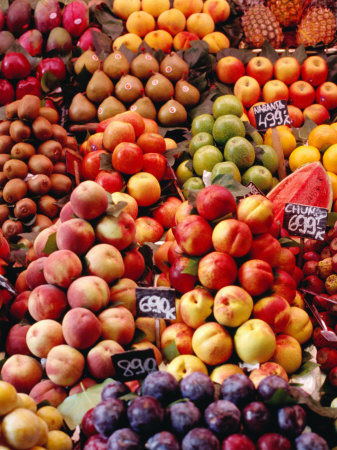
Fruitful, colorful Mercat
Either way, when in Spain, have yourself some good time, the beach is amazing, the churches are majestic, the monuments are historical and Gaudi's work is not-to-be missed! Bicycle around the city, enjoy some seriously Del-iii-cious food and make sure to pass by the colorful public market in Barcelona: La Boqueria Mercat!

Saturday, September 17, 2011

Harvard's Healthy Eating Plate!

After introducing the USDA's MyPlate back in June, Harvard is now releasing its own modified version of the plate: the "Healthy Eating Plate" to which some - healthy & useful - changes have been made!


Here is what the Healthy Eating Plate recommends:

  • Make half your meal vegetables and fruits. I always love emphasizing on the importance of veggies in one's diet and this plate serves us right! If you notice, they mentioned that potatoes and french fries don’t count as vegetables, a point most people mention when you tell them fries are not veggies! So there you go, plain and simple.
  • Choose whole grains whenever you can and limit refined grains such as white rice and white bread because they are broken quickly by the body, leading to a less sensation of satiety and quicker feeling of hunger.
    Now what I loved about this is that when you say the word "refined carbs", many may think of pastries alone but few may relate the word "refined" to white bread and white rice, so now you know!
  • As for your protein intake, it's time to let go any red meat, bacon, cold cuts and processed meats! Go with healthier sources of protein, such as fish, beans, nuts and poultry!
  • Healthy oils (like olive oil and canola oil) are recommended here! For many years, fats have been demonized to "cause" an increase in obesity prevalence world-wide! Now I am not saying they are not, but nowadays, studies have showed that different types of fats (Mono/polyunsaturated VS saturated/trans/hydrogenated) have, in fact, different effects on one's health! In addition, recent studies are drawn to "blame" refined carbs as much as unhealthy fats, so quality and quantity of all carbs, fats and proteins are crucial for a balanced diet.
  • As for your beverage choice, drink water, tea, or coffee (how many cups??) with little or no sugar: a very important point to emphasize - avoid added sugars, go easy on juices and sugary & fizzy drinks! Moreover, what I loved the most is limiting milk and dairy to no more than 1-2 servings per day! They are not must-have foods so when you have your labne/yogurt/milk/cheese in the morning, don't have another for lunch! Recent studies have been pointing out to the "not so wonderful" effects of dairy products! More research is definitely needed; however, dietary guidelines are being influenced by food politics (meat and dairy industries) so let's wait and see!
  • Last but not least is to stay active - a very important aspect, so forgotten in the USDA's Myplate! Exercise is the most essential habit you can adopt along with a healthy dietary habits!
The USDA is being influenced by food politics - but to what extent exactly? Food industries and agriculture interests are affecting MyPlate more than science. Now of course MyPlate was based on scientific research but one can't deny the fact that meat and milk industries are exerting their own influence. So let's hope the Healthy Eating Plate is based on nutritional science more than external non-scientific influences!
Better yet, my question is: To what extent does this improved plate really reflect what the Lebanese community is ought to eat?

We're being featured!

My beloved blog is being featured in RagMag magazine this month in their Ohm issue, among 2 other amazing and informative health blogs: Strawberry Blu and Point a la Ligne!
My blog seemed to be in the issue that I mostly loved, Ohm-ing your way to awaken your chakras and connect with the universe! So learn more about mantras, chakras and yoga and adopt yourself a better & healthier lifestyle while you're at it!

Thanks to Lebanon Aggregator!
PS: This post is for archiving purposes only, I mean I have to remember my first feature!
Way to go my nutrition world!
Photo source: Lebanon Aggregator

Friday, September 16, 2011

Delicious Lebanese Apples Event: Tefeh el Tayeb!


I just love Tawlet Souk El Tayeb events!
After their famous and successful National Tabboule Day, Souk et Tayeb is bringing us the delicious Tefeh El Tayeb 2011!

So meet Souk el Tayeb on Saturday the 24th of September, from 9 am till 2 pm in BIEL and learn everything about apples in Lebanon, taste different apple types, help local producers make Apple Jam, Compote and Debes El Tefeh and vote for the best apple dessert!

Tuesday, August 30, 2011

Sugar, Not So Sweet Afterall!

Sugar is everywhere we look! We, by nature, like comfort foods, sweets and sugar! In fact, sweet is the first taste humans prefer from birth, so it's no surprise that we tend to gulp sweetened foods and beverages! 
But why!
Humans have this preference for sugar largely because carbohydrates stimulate the release of the feel-good brain chemical serotonin which affects brain cells related to mood, sexual function, sleep, memory and learning, temperature regulation, and appetite. Thus carbs and sweets affect us more than we know it! 

Some examples of when sugar can lurk around in foods and drinks are coffee, cocktails, milkshakes, regular soft drinks, iced tea, fruit juices, sports drinks, energy drinks, salad dressings, cake mixes, ice cream, chocolate bars, jelly, cookie, pastries, sweets, knefe, croissants, cornflakes, chocolate spreads! And even though sweetened beverages are just liquids, these drinks provide you with empty calories more than beneficial nutrients and can pass by unnoticed especially in hot, humid weather, gulping one drink after another!

But sugar can be tricky, so how to detect it?
Spotting added sugar on the food label requires a bit of detective work. Food and beverage manufacturers must list the product's total amount of sugar per serving on the nutrition facts label. This is why you will need to scan the ingredients list of a food or beverage to find that added sugar! Note that all ingredients are listed in descending order by weight, yup! Therefore the relative position of sugar in the ingredient list is crucial and can give you an idea of whether the food contains a lot of sugar or just a little as compared to the other ingredients.
Added sugars go by many different names, yet they are all a source of extra calories! So here's a small list of what sugar can go by:


Moreover, if the label says "no added sugars", it should not contain any of the above mentioned sugars, although the food could contain naturally occurring sugars (such as lactose in milk for example). However, note that although these foods don't contain high sugar ingredients and no sugar was added during processing/packaging, foods without added sugar may still be high in carbs!
So in order to know how much exactly is a gram of sugar: One teaspoon of granulated sugar equals 4 grams of sugar. To put it another way, 16 grams of sugar in a product is equal to about 4 teaspoons of granulated sugar, so do the math!
Remember, your body doesn't care what the label says, it's all just "sugar"! Read the ingredients and watch out for drinks and foods that are high in sugar. Having a lot of sugar whether from food or sweetened beverages can lead to gaining extra weight, even in active people!

References:

Monday, August 29, 2011

Zuwwedet Aline - A Healthy Vegetarian Night in Lebanon


Aline is making us some healthy vegetarian food on the 5th of September from 8.00 pm till 11.00 pm at Tarek Booze in Gemmayze! So give yourself a break from all those trans and saturated fats, refined carbs and unhealthy meals and enjoy some delicious vegetarian food under the theme of green beans and corn!

Vegetarian diets are known to be low in saturated fats & high in fibers! The consumption of a generous supply of whole grains, legumes, nuts, fruits and vegetables provides protection against chronic diseases such as cancer, cardiovascular disease and diabetes. A plant based diet is rich in its content of health promoting factors such as the many phyto-chemicals and antioxidants. Keep in mind that, when planned well, a vegetarian diet can provide you with all the nutrients, vitamins and minerals your body needs.

So fit such nights into your schedule, you'll be doing your health a favor!
For more info, you can call Tarek Booze at 03.148890

Zuwwedet Aline poster

Sunday, August 28, 2011

"Breastfeeding Basics" Seminar

Even though breastfeeding is nature's way of providing nutritional needs for infants, the "art" of breastfeeding and the techniques may not come as naturally!
Therefore, Moms and to Be is organizing a public seminar targeting working mothers, mothers with newborns and moms to be planning to breastfeeding to provide them with credible, trust worthy information about breastfeeding basics, essentials and practical tips from a certified breastfeeding specialist!

So when and where is it?
It will be held in Sin El Fil cultural center, Lebanon on the 6th of October from 4.30 pm till 7.30 pm.

What's cooking in this seminar? 
  • Basic principles of breastfeeding
  • How to increase milk flow
  • Breastfeeding positions that are helpful for comfortable and successful lactation
  • Early hunger cues of babies
  • Babies needs of water and vitamins
  • Dad's role in the breastfeeding process
  • Feeding babies at night time
  • When to introduce bottle feeding
  • What to do if moms are sick
  • How to know if babies are getting enough milk for proper growth and development
  • The process of pumping and storing milk
  • The recommended duration for breastfeeding

The session will be fun and educational! Starting 4.00 pm, there will be a welcome coffee break and snacks will be ready for early arrivals and better yet, a special animation is foreseen for your kids all through the session! Free parking is also available at the center so for more information, contact 01.566 999!


Friday, August 5, 2011

Breastfeeding Week in Lebanon

Al-Safir Website [Link]
I love it when issues as important as increasing awareness about breastfeeding are emphasized on in Lebanon. In fact I got this online article via http://daasetsobbat.blog.com/ aka @Yara_Assi who actually participated in making this event a successful one!

Spread the word about breastfeeding and provide every mom and mom-to-be with this user friendly, very beneficial Hotline: 03.824100 that provides useful information and tips about breastfeeding!

The Art of Breastfeeding

Just like learning a new skill, knowledge, practice and support from family, friends and coworkers are the key to perfecting the "art" or techniques of breastfeeding.

It is important to discuss your decision with your doctor before delivery and inform your hospital staff in order to provide you with a breastfeeding friendly environment as soon as you arrive to the hospital!

Warming up & getting started 
To help ensure an adequate milk supply and build confidence, start nursing as soon after delivery as possible >> within 20-30 minutes after your baby is born, perhaps in the delivery room. This is why it is important to remind the hospital’s staff of “rooming in” with your infant.
The first feeding will be most probably short, for about 10 minutes. Find a comfy chair with a good arm and back support or lie down with pillows positioned to help support your baby. This way, you won’t feel any tension in your neck, back or shoulders and it’ll be easier to hold your baby while breastfeeding him/her. Keep in mind to plan to nurse your infant on demand, that is, whenever your baby decides it is time to eat.
Signs that your baby is hungry: If your baby is mouthing, rooting toward your breast, playing with his mouth and tongue and has an increased alertness. Usually, crying is a let sign of hunger so learning the earlier signs of hunger could be helpful to better understand your baby’s hunger schedule.
During the first months, be prepared to nurse very frequently: about 8 - 12 months every 24 hours. A newborn’s stomach is small and his nutritional needs are exceptional during this period of rapid growth and development. Frequent nursing helps establish your milk supply and keeps your breasts from becoming hard and swollen. 

Latching on 
Some newborns instinctively suckle when they are first put to their mother’s breast while others take time to get used to the process, but either way is normal. Latching on correctly helps your baby get enough milk and protects you from sore nipples.
>> Help your baby by stroking your baby’s cheek or lower lip nearest to your breast.
>> As your baby turns toward your nipple, guide your baby’s mouth. Newborns have a “rooting reflex” at the breast thus they open their mouths naturally.
>> Try to offer both breasts at each feeding. Let your baby nurse as long as he or she wants – about 10 to 20 minutes on each breast. The longer they stay the more of the “hind milk they take. This milk is higher in fat and helps the baby feel full and satisfied.
Make sure to wash your hands before nursing. 


Breastfeeding – About Your Baby 
Burp your baby when you change breasts and at the end of the feeding. This relieves any discomfort from air swallowed while nursing. Hold him or her upright on your shoulder or lay your baby tummy side down across your lap. Then gently rub or pat your baby’s back. It is normal for a baby to spit up a bit of milk.
Trust your baby to let you know when he had enough to eat.
Signs of fullness: Your baby may close his or her lips, turn away or even fall asleep. Sometimes babies rest during a feeding as well, so this makes it hard to know when one feeding stops and the next begins.

Breastfeeding – About You 
Because babies nurse more energetically when they start breastfeeding, alternate the breast you offer first.This will help ensure that both breasts are empties regularly and helps you prevent breasts stiffness. If your breasts feel tight and full, soften the by expressing a small amount of milk by hand or breast pump. Fullness and discomfort are signs of engorgement and may happen when your milk supply first comes in or if you have gone too long between feedings. Feed you baby often and if your baby is not hungry yet, you can store the milk in a clean container and refrigerate it, then offer it in a cup later on. 
Don't forget to hydrate yourself well during the day!


Book reference: Complete Food and Nutrition Guide, ADA
by Roberta Larson Duyff, 3rd ed.

Photo references:
World Breastfeeding Week Logo 
Mother and infant 
Breastfeeding Rocks

Monday, August 1, 2011

7 Things You Gotta Know About Coffee


  • Coffee has its different national days in some counties that are actually public holidays. In Japan, for instance, October 1st is 'Coffee Day'. In Ireland, it is September the 19th, and in Costa Rica it is 12th September.There's no such thing in Lebanon, at least not yet!
  • A cup of black coffee does not contain any calories if served without sugar, yet is still contains the caffeine. And even if you decide to go decaf, you'll still get some of that caffeine. In fact, if you drink 5-10 cups of decaffeinated coffee, you could get as much caffeine as from 1-2 cups of caffeinated one.
  • More than 1.4 billion cups of coffee are consumed each day worldwide and it takes around 40 roasted coffee beans to make just one single espresso shot!
  • Caffeine is not the main bitter compound in coffee; it's just responsible for 15 % of the bitterness you taste. The rest is due to antioxidants that form during the roasting the coffee beans.
  • The traditional espresso machine was actually invented in France, not in Italy, bummer! However, the Italians took this idea, perfected it & made it their own and nowadays, the best espresso coffee machines are still made in Italy. Note that espresso in Italy is rather too important to be consumed with a meal. It is treated as a separate event and is given its own time after the meal.
  • The most expensive coffee in the world comes from Civet poop. Civets are cat sized mammals that only ingest fine ripe berries and excrete them partially digested. Yup the partially digested berries are those fine coffee beans! Believe it or not 1 pound (around 1/2 kg) sells between 120 and 600 $.
  • Last but not least, here's a quick mini poster that would help you to decipher all those coffee options next time you're ordering/making one: Make sure to go decaf, get yourself some skimmed milk & lay low on those added sugar, cream, syrups, toppings and chocolate chips! You can read more about what to choose when ordering/preparing your coffee here.
Illustration by Lokesh Dhakar


References:

Breastfeeding – The Baby Friendly Way for August

The 1st week of August is the “Breastfeeding Week” when all countries around the world announce their pledge to the importance of breast feeding and its promotion around their nation.
Every country should put specific health objectives to increase the incidence of breastfeeding and this is increasing around Lebanon. This is a must to overcome any barriers that cause a decrease in breastfeeding norms such as:

•Lack of knowledge about the importance and benefits of breastfeeding
•Absence of work facilities or policies that support lactating women ( for example: extended maternity leave, part time employment, facilities for pumping breast milk, child care on site set, etc.)
•Advertising bottle feeding
•Lack of breastfeeding support 

Therefore, to promote breastfeeding, every maternity facility, hospitals, health professionals and dietitians should follow ten steps recommended by the World Health Organization:

•Hospitals should develop written breastfeeding policies that are communicated to all health care staff.
•Allow rooming in once the baby is born; that is, mothers and babies should be together in the same room 24 hours a day.
•Facilities should train its staff to implement such policies.
•Pregnant women should be educated and informed about the importance of breastfeeding and how to manage it in a successful way.
•Breastfeeding should be initiated half an hour after delivery and staff in hospitals should highly recommend that.
•Demonstrate to mothers how to breastfeed and to maintain lactation even if they should be separated from their children for medical reasons.
•Encourage breastfeeding on demand.
•Health care professionals should refrain from giving newborns any food or drink other than breast milk unless it is medically indicated.
•No artificial nipples or pacifiers should be given to breastfed newborns.
•Hospital staff should refer mothers to breastfeeding support groups or dietitians after being discharged.

Today, more than 20,000 maternity facilities worldwide report ever having achieved Baby-friendly status. So whether the hospital you deliver your baby in is baby-friendly or not, you know what the “Ten Baby-friendly Tips” are and yes, it is possible that you implement them yourself. Ask your doctor and the nurses helping for your own “baby-friendly” way. Go for breastfeeding for both you and your baby.

References:
Mom & infant photo

Sunday, July 31, 2011

Test the Age of the Egg You're About to Have!

There are 2 ways in which you can know if the egg you're about to eat is fresh or old!

ONE 
Place the egg in an empty bowl and fill it up with cold/room temperature water such that it covers twice the egg's level.
>> A fresh egg will immediately sink to the bottom of the bowl
>> While an older egg would tend to float
Why? In a fresh egg, the air cells in it are very small, making the egg quite heavy compared to the water holding it. As for old eggs, more air enters the egg's shell as it ages. Therefore you could see that its curved end point touches the bottom of the bowl whereas its body points upwards. If this is the case, then the egg is fine to consume. However, if the egg you're experimenting on floats completely - no tip is touching the bottom of your bowl, well then, it's time to toss it out!

TWO
Bring that egg of yours and crack it on a plate!
>> A fresh egg with have thick cloudy colored whites, compacted firmly and close to a well leveled yolk
>> An older egg will have a less thicker & more transparent color for the whites with flat leveled yolks that could easily break
Why? Carbon dioxide (CO2) which makes egg whites cloudy and firm is present when the egg is freshly laid. As the egg loses its freshness with time, the CO2 escapes the shell thus egg whites become less thick, more transparent in color and tend to break easily from the yolk than fresh eggs would. 

So now you can experiment!
For many more cartoons, please visit Randy's site @ www.glasbergen.com.

Saturday, July 30, 2011

What's It Like Gym-ing in Curves?


Curves is an international gym for women in which you can exercise for 30 minutes a day on both strength training & cardio machines. More people are talking about it around me so I decided to decipher this worldwide known gym!

Pro
Circuit demo of 13 strength training
& recovery stations for 30 mins
  • The program starts with a pre-assessment test asking participants about their eating habits, in/active lifestyle, medical history, readiness and motives for seeking a healthier lifestyle
  • Staff members take anthropometric measurements such as weight, height, body fat percentage, waist to hip ratio, etc. Then they calculate your BMI and compare the anthropometric measurements to "ideal" or healthy standards >> personalized coaching is definitely a plus! This way, the trainer will keep track of any body changes; you'll be followed up all the way!
  • Exercising is by stations. As seen in the photo above, a circuit demo with 13 strength training machines with recovery stations in between. You spend 30 seconds on each station with 30 seconds recovery for 30 minutes total.
    >> The strength machines increase your heart rate such that you can burn 500 calories per a 30-minute session. You focus on both upper & lower muscles like your
    biceps, triceps, abs, hips, chest, hamstrings, etc.
    >> The recovery stations are placed in between exercising machines on which you can run, walk or jog in place to maintain your heart rate.
    Thus both stations provide you with interval training of muscle toning and cardio.
  • Trainers work on motivating you in your 1st interview by asking you to repeat statements like "I am my own boss, I'm doing this for my own self, I am willing to exercise at least 30 minutes, 3 times a week." They also motivate you throughout your 30-minute workout.
  • The music is new, lively and timed - asking you to change station every 30 seconds.
  • The facility provides you with showers and lockers
  • They offer you a 1st visit discount and discounts for students. This way you'll pay 32 $ per month instead of 50$.
  • They have 7 different Locations in Lebanon and 10,000 locations in 85 countries so if you want to travel , there's actually a travel card you can take to enable you to keep on exercising worldwide.
Con
  • To start with, the Zouk Mosbeh's location has a valet parking! Well that's fine, I mean if you don't want valet, you can park it yourself. But nope! That's not the case, there's no parking so you are bound to give it to the valet. So now, gyms have valets in Lebanon.
  • The 30 minute rule is seriously strict. You can't exercise more. Now the recommendation is 60 minutes per day, so let's say you are that motivated and want to spend 30+ mins exercising, you can't actually do that! You might be short on time today but can exercise 2 hours tomorrow, like my case - Nopes!
    The 30 minutes could be considered an advantage especially if you're reluctant about exercising - it's a good strategy to at least start exercising and finish the whole 30 minutes - if you're not active at all. I mean one could say 30 minutes are achievable and reasonable to do per day and that's what could classify the "30 minutes" as pro as well
  • In Curves' Zouk Mosbeh location, there were no dietitians and no trainers - Only students working as part time trainers. Now they are in fact trained to assess & motivate you, but I really think graduate trainers & dietitians are ought to do this! I have heard that other Curves facilities have trainers and dietitians, so they could be short on staff in this location.
  • You can't enroll for one month only and renew if you like the gym/whenever you can. Memberships are by 4, 6 or 12 months only.
  • They don't open on Sundays and open from 8 till 8!

So if you're thinking of joining a gym:
>> If you are self motivated, ready to commit and you want to exercise more than half an hour per session, almost all gyms have licensed and certified coaches while some even have dietitians. Get in contact with them before enrolling in your nearest gym and ask them if an exercise could be tailored specifically for you, with constant follow up!
>> If you need the push and the motivation but lack the commitment, Curves staff will make sure you finish the whole 30 minutes you're exercising with funky music & muscle strengthening along the side! 

References: