Showing posts with label Nuts. Show all posts

Wednesday, September 10, 2014

Spinach, strawberries, almonds and feta...

I visited my brother few weeks back for a completely carefree vacation in Washington state where organic baby spinach and strawberries were in season! I know these are not in season in Lebanon right now, but I find it hard not to share this recipe especially that it's super easy to make, it's absolutely refreshing and I've been meaning to try it ever since I saw a similar salad up on Foodess.

What you need to have:

For the salad
  • 150 grams baby spinach, rinsed, dried and cut into bite-size pieces
  • 150 grams strawberries - cleaned, hulled and sliced
  • 75 grams almonds - roasted, unsalted and chopped
  • 100 grams feta cheese, crumbled or diced
Fro the dressing (all Jazmin's idea, and it fits the strawberry spinach blend perfectly!)
  • 2 tbsp extra virgin olive oil
  • 1 tbsp white wine vinegar
  • 1 tbsp mustard, whole grain Dijon
  • 1 lemon, juice with pulp
  • 1 clove of garlic, finely grated
  • 1 small shallot, finely grated
  • 1 tsp of salt
  • 1/2 tsp of black pepper

What you gotta do:
  • Mix the spinach and the strawberries together. Set them aside while you prepare the dressing.
  • Then whisk all the dressing's ingredients altogether. I actually shook them inside a tightly closed jar, so they turned out pretty creamy and well blended.
  • Drizzle the dressing on top of the salad and mix.
    Make sure not to add the dressing, unless everyone is prepared to start eating as the white vinegar will wilt the spinach if left for a long time.
  • Sprinkle the chopped roasted almonds and the crumbled feta on top of the salad, and please be generous. If you tend to be stingy, set aside 2 tiny bowls, one for feta and one for the almonds, just in case anyone wants to add some more.

And voila...
Pungent, tarty and refreshing for the taste buds!


Needless to say, the salad was a hit, the extra almonds and feta were much appreciated, summer was good and my trip was both relaxing and active at the same time. I took a photo of how my most relaxing day looked like at Lake Union's westernmost point in Freemont.


Statue of Peace Leader, Sri Chinmoy at Lake Union


Friday, May 3, 2013

My Healthy Homemade Peanut Butter

I assume they mean something extraordinary,
especially that the brain creates new neural pathways with new experiences!
However, cooking new (easy) recipes and exploring the healthier side of snacks are on my to-do list.


Still 'revolting for food' with the Food Revolution Day coming up on the 17th of May, I'm creating my own homemade peanut butter for the first time! 

I love peanut butter, it's delicious, creamy, nutty and in the same time a healthy snack! Of course, it's caloric dense but in the same so rich in nutrients! Peanuts provide you with the good kinda fat, monounsaturated ones, along with minerals (copper, magnesium, manganese, iron), vitamins (E, B6, folate, niacin) and antioxidants (p-coumaric acid & resveratrol).
Sugar and hydrogenated vegetable
oil 
are major ingredients in
commercial peanut butter!
It has been a while since I last had peanut butter so I went shopping! Nevertheless while shopping for peanut butter, I couldn't help but notice most were super processed with hydrogenated fats and sugars. 

So I decided to make my own. Turns out, the 'recipe' is super easy. I got raw unsalted peanuts, dry roasted them in the oven, blended them and voila. It's really this simple! The whole process took around 20 minutes tops. 


Ingredients
  • 400 grams raw peanuts (depending on how much you want to make)
  • A pinch of salt, honey, molasses or unsweetened cocoa powder, if desired

Instructions
  • Spread the raw peanuts evenly in a pan and roast in your oven for around 8 minutes. Stir the mix mid-way. You can make the butter with raw peanuts, but roasting really enhances the flavor!
  • Blend the roasted nuts in your food processor (Steps 2 through 8) for 10 to 12 minutes.
    > Make sure not to blend them for straight 12 minutes, it might burn your food processor;s motor. 1-2 minutes per spin will do.
    > Don't worry about adding any extra oil. Once crushed, the peanuts release their own oils, softening the blend.
    > After every spin, briefly scrap down the mix with a spoon.
  • I wanted mine crunchy so I took few tablespoons from step 3 and mixed them with the final peanut butter product (Step 9).
  • I added a pinch of salt throughout the whole process. I don't like mine sweet so I didn't have to add any honey. So this depends on your taste buds!
  • Place your healthy peanut butter in a container and refrigerate. Now note that given its natural peanut butter with no emulsifiers, you will notice that the oil will slightly separate to the top when stored. Just stir it a bit before use.
So my healthy May after-workout snack was peanut butter with bananas and crushed hazelnuts. Quick, easy, satisfies my cravings and healthy!


My next butter, probably next month, will be cashews butter, rich and creamy!

Monday, January 9, 2012

Yansoun w Joz!

During this cold in Lebanon, I love to curl up with a warm drink! Today I went for a cup of an after infusion of anise with some raw walnuts on the side, it's actually my dad's favorite.
I just took 1 teaspoon of yansoun seeds, slightly crushed them to release their volatile oils and boiled them in water for 5 minutes. Antonio Tahhan preferred to have his anise with a man2ouche on the side; nevertheless, you can check here how he prepared his anise infusion a la Libanaise!

Anise benefits
Not only is it sweet with no sugar at all, it's absolutely warming! 
  • Anise seeds have antioxidant effects, according to a 2007 study published in the journal "Food Chemistry". Its powder and extract exhibit significant antioxidant activity, with at least 25 antioxidants such as flavonoids like quercetin, and cumarins !
  • Anise active compound, anthole, has been found to be antifungal and antimicrobial.
  • The seeds contain vitamin C, B1, B2 as well as iron, potassium, sulfur and phosphorus. They also have galactogenic properties to induce milk production in breastfeeding women.
  • Anise seeds have been used to relief indigestion, colic, gases, abdominal cramps and nausea. However, in Lebanon, it is quite the tradition to boil anise seeds and add them with infant formulas to help in relieving infants' colic. But it's not the wisest decision - anise infusions cannot be filtered properly by infants' kidneys and thus it is advised to let go such 'tradition'.
  • As for anise oils (not its seeds), they may work as an expectorant, helping to cough up of mucus in conditions like asthma, bronchitis and the common cold. Keep in mind that when using anise oils, large quantities may cause nausea and vomiting, seizures and even pulmonary edema so don't go buying oils and using them on your own. Always consult your health care provider!

As for walnuts
  • Walnuts are 62% fat, mainly polyunsaturated fatty acids, such as linoleic acid (omega 6) and linolenic acid (omega 3). Omega 3 is known for its ability to aid in reducing cholesterol levels in the blood, preventing formation of clots and reducing inflammatory processes. Actually, walnuts is one of the best vegetable sources of omega 3, along with canola oil!
  • Walnuts are also a good source of proteins, more than peanuts but the same as almonds. They may lack some essential amino acids, but when combined with whole grains, it's a complete source of proteins.
  • Walnuts are also a good source of vitamin B1 (thiamin) that is necessary for the function of the heart and stability of the nervous system and especially B 6 (pyridoxine) that is involved red blood cell production and proper brain functioning! This is why walnuts have been associated with helping in coronary heart diseases and disorders of the nervous system.
  • As for minerals, walnuts are rich in phosphorus and potassium, while being low in sodium -  a great combination for promoting heart health. They also contain magnesium, iron, calcium, zinc, copper and manganese, an absolutely rich cocktail!
  • Walnuts are the nuts with the highest caloric content, due to their high fat (oil) content. In fact, ONE walnut (with 2 halves) contains 26 calories! This is why just don't place the whole walnuts bag in front of you, it's very easy to overeat. Just place a small handful of nuts on the side of your cup and enjoy!

Thursday, June 9, 2011

It's Cracking Almond Nuts Time!


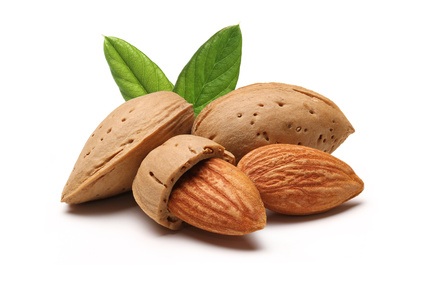
Packaged almonds are available year around, but now it's time for fresh almonds in Lebanon! We refer to almonds as nuts, but in fact, they are technically the seeds of the fruits of almond trees, which are actually cousins of peach, cherry and apricot trees! The fruits that almonds tree bear have pits or seeds, which, at the 1st stage of maturation, are gelatinous and milky but during this time of year, they become solid white, fully formed, fresh and crunchy! Almonds have been part of the human diet from immemorial times and their intake increase in Lebanon, especially during summery days!

Almonds contain a high percentage of proteins (13.3%) bearing in mind that this is a vegetable product while meat and fish possess between 15 and 20 g for each 100 g. They also contain fat for more than half of almonds weight is formed of predominantly monounsaturated and polyunsaturated fatty acids.
Almonds are relatively rich in vitamin B 1, vitamin B 6 and above all vitamin E as well as almonds are among the richest plant based foods in calcium and phosphorus with significant amounts of magnesium, potassium and iron.

Almonds, freshly picked from the tree and shelled, can be eaten as they are. They are more digestible that dried almonds and I usually use my teeth to open them, but using a nut cracker is definitely safer. As for dried almonds, the moisture content would be reduced and thus they become hard. They can be eaten raw but when very well chewed, or lightly toasted. They can be easier to chew and digest is soaked overnight. The next morning they will have become tender and after removing the skin that covers them, they give the sensation of having been freshly picked from the tree, yet we all know, deep down inside, that it's not the same fresh taste!


During afternoons or night gatherings in Lebanon, most people enjoy cracking almond fruits, along with sipping beer. However, keep in mind that almonds contain 589 calories in 100 grams and therefore you can get around 200 calories in just 1/4 cup!
So think about it! With just 1 beer = 150 calories, and just 1/2 a cup of almonds = 400 calories, you'll end up with - believe it or not - 550 calories worth of mindless munching!